Reminderly.ai vs Tasks.Bot for AI Agent Creation Software
You searched for AI agent creation software and landed on two very different tools. One builds autonomous agents; the other, Tasks.Bot, assigns and tracks tasks inside WhatsApp. Choosing wrong means paying for capability your team will never open, or missing the one that fits how your staff already works.
This comparison explains what Tasks.Bot actually does, where its AI stops, and how it stacks up against Reminderly.ai for agent-building use cases. You will see feature, pricing, and trust-signal differences, then get a clear recommendation on which tool fits your team.
What Is Tasks.Bot? AI Task Management Inside WhatsApp
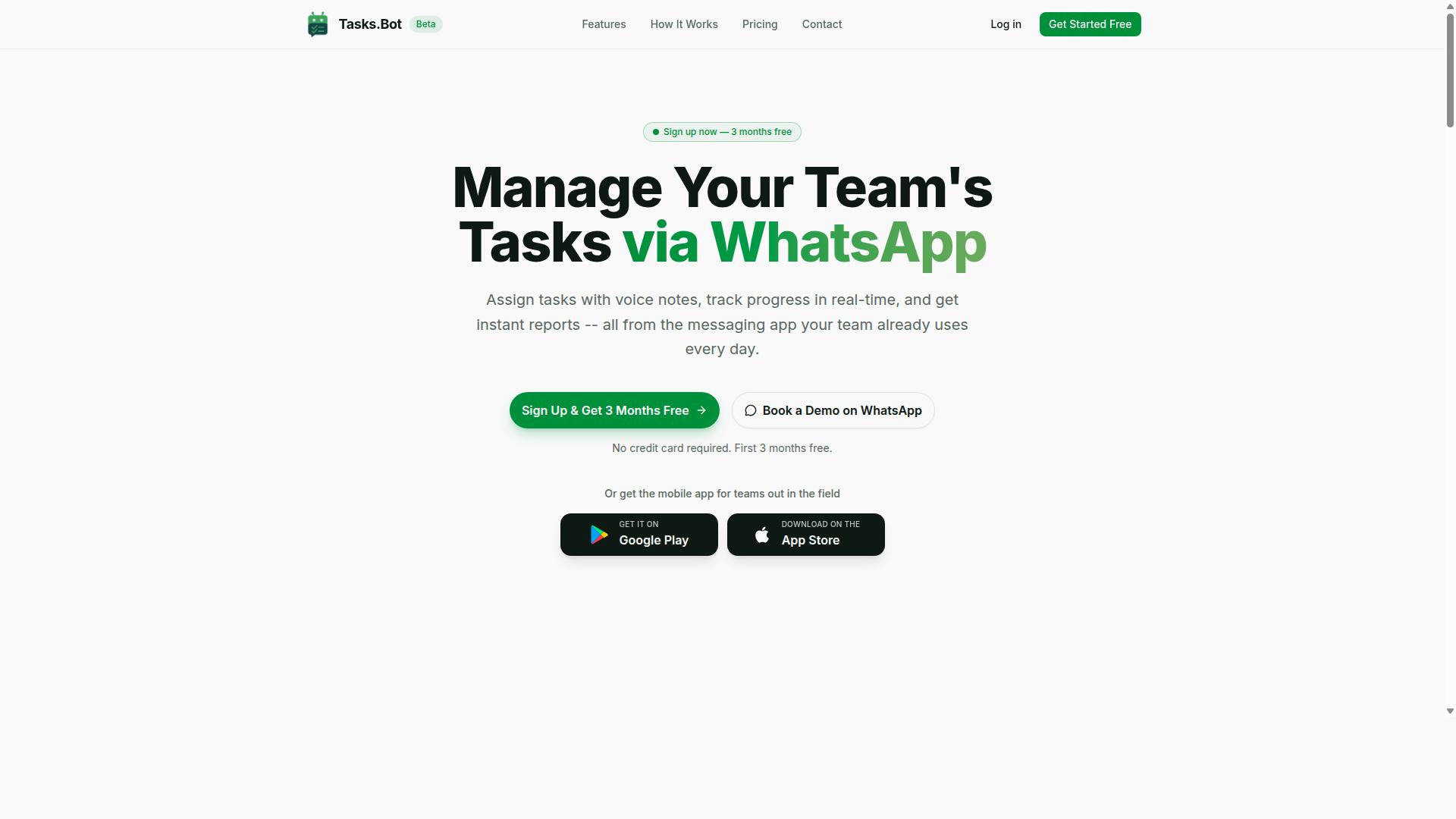
Tasks.Bot is a task management platform that operates entirely within WhatsApp, allowing teams to assign tasks, track progress, and receive reports without leaving the messaging app. That single design decision separates it from most productivity tools, which ask users to adopt yet another dashboard, login, and notification stream.
Instead of pulling teams into a new environment, Tasks.Bot meets them where coordination already happens. Task assignment, progress tracking, and reporting all run inside WhatsApp, so the platform fits into existing habits rather than competing with them.
For field-based operations, Tasks.Bot also offers a mobile app that supports teams working away from a desk. The service is currently in beta and includes a free trial period, which gives teams room to evaluate whether a WhatsApp-native approach suits how they already work.
The core benefit is simplicity of adoption. There is no new software to install for everyday use and no separate accounts to create, which removes the two most common reasons task management rollouts stall: setup friction and low participation. When the tool lives inside a messaging app people already open dozens of times a day, the barrier to logging a task or updating its status drops sharply.
It helps to place Tasks.Bot in context. The wider market for AI agent creation software, AI agent builders, and no-code AI platforms focuses on building autonomous agents, chatbot development, and workflow automation powered by large language models. Tasks.Bot takes a narrower, more practical path: conversational AI applied directly to task management, team collaboration, and reminder automation inside a channel teams already trust.
Who Tasks.Bot Serves: WhatsApp-First Teams and Field Staff
Tasks.Bot is designed for teams that already rely on WhatsApp for communication, especially those with field staff who need to manage tasks, track attendance, and log hours for payroll. The site notes that hundreds of teams already use the service, which suggests the WhatsApp-first model resonates with a specific kind of operation.
That audience tends to share common traits. Coordination happens in group chats, staff are often mobile rather than desk-bound, and formal project management software has historically struggled to gain traction. Tasks.Bot targets exactly this gap by keeping task management inside the channel those teams already use daily.
Field staff benefit in particular. Attendance tracking and payroll-ready hours are built into the platform, so time data is captured as part of normal communication rather than through a separate timesheet process. For supervisors, that means fewer follow-ups and less reconciliation at the end of a pay period.
Because the service is in beta with a free trial, it suits teams that want to test a WhatsApp-native workflow before committing. The mobile app extends the same experience to workers who rarely sit at a computer, keeping task management and attendance within reach wherever the job takes them.
In short, Tasks.Bot is a strong fit for organizations whose teams live in WhatsApp, whose staff work in the field, and who want task management, attendance, and payroll-ready hours handled without introducing new software or accounts. For those teams, it is a practical and credible choice.
Is Tasks.Bot an AI Agent Creation Tool? Setting the Record Straight
While Tasks.Bot leverages AI for task management, it is not an AI agent creation platform like those built for designing autonomous agents or multi-agent systems. This distinction matters because the phrase "AI agent" gets used loosely, and readers comparing tools can easily assume that any product with AI in it must also be an AI agent builder.
Tasks.Bot is a task management service delivered through WhatsApp, with companion Android and iOS apps. Its AI exists to understand what a user means and turn that intent into an actual task. That is a very different job from giving someone the tools to construct, train, and orchestrate an autonomous agent.
Platforms focused on AI agent creation software typically offer things like no-code or low-code agent builders, prompt engineering interfaces, context management, memory retention, and support for multi-agent systems or agent orchestration. Some also provide chatbot development frameworks, large language models configuration, GPT integration, API integration, and webhook support for chaining agents together.
Tasks.Bot offers none of these agent-building capabilities. It does not provide a canvas for designing autonomous agents, a prompt engineering workspace, or a way to connect multiple agents into a pipeline. Anyone looking for that kind of tooling would need a dedicated agent platform, not a task management app.
What Tasks.Bot does provide is AI applied to a practical, everyday problem: getting work captured, assigned, and completed. The confusion likely comes from the word "AI" appearing in both categories. But using natural language processing to interpret a message is not the same as building a system that reasons, plans, and acts on its own.
For teams evaluating tools, the honest framing is simple. If the goal is to build and deploy autonomous agents, Tasks.Bot is not the right category of product. If the goal is to run task management and workflow automation for a real team, its AI is aimed squarely at that.
What Tasks.Bot's AI Actually Does: Natural Language and Voice Note Task Creation
Tasks.Bot's AI is focused on simplifying task entry: team members can create tasks by sending a voice note or typing in natural language, and the system automatically parses the details. Instead of opening a form and filling in fields, a user can simply describe what needs to happen and let the service interpret the intent.
This is the core of how the AI is applied. It reads or listens, works out what the user wants, and creates the task from that message. The result is faster capture and less friction for people who are already messaging all day.
Beyond creation, the platform supports a range of task management features that keep work moving:
- Voice note task creation and natural language understanding
- Automatic task assignment
- Smart deadline reminders
- Approvals and automations
- Instant reports
- Tasks on a map
- Live day tracker
- Face-verified attendance
- Shifts, leave, and hours management
Each of these sits inside the task management workflow. The AI helps interpret intent and create tasks, while the surrounding features handle assignment, reminders, approvals, and reporting. None of it involves designing an agent, tuning prompts, or managing context across a multi-agent system.
Consider a practical example. A team member sends a voice note saying that a client delivery needs to be ready by Friday and should go to a specific colleague. Tasks.Bot parses that message, creates the task, and routes it to the right person. The user never filled out a form or wrote a prompt.
That is the whole point of the design. The AI is a layer that makes task management feel like a conversation, not a configuration exercise. It is reminder automation and task automation in service of a team, not a toolkit for building autonomous agents.
The same logic applies across the rest of the platform. Smart deadline reminders keep tasks from slipping. Approvals and automations move work through the right steps. Instant reports give visibility without manual compilation. Shifts, leave, and hours management keeps scheduling in one place. All of it is productivity tooling for teams, supported by AI that understands messages.
So when the question is whether Tasks.Bot belongs in the same category as AI agent builders, the answer is a clear no. It is a task management and team collaboration tool with AI-powered input. Its strength is making task creation effortless through natural language and voice, backed by native WhatsApp integration and mobile apps with push notifications, voice capture, and a home screen widget. That is a genuinely useful product, just not an agent creation platform.
How Tasks.Bot Compares to Reminderly.ai for AI-Driven Task Workflows
Tasks.Bot and Reminderly.ai both aim to automate task workflows, but they take fundamentally different approaches: Tasks.Bot operates inside WhatsApp, while Reminderly.ai is built for creating custom AI agents. That single distinction shapes everything about who each product serves.
Tasks.Bot is a ready-to-use task management tool. It lives inside WhatsApp, understands natural language and voice notes, and gives teams a working task automation system from day one. There is nothing to build, configure, or maintain.
Reminderly.ai, by contrast, sits in the AI agent creation software category. It gives teams the building blocks to design custom autonomous agents, manage prompts and memory, and connect those agents to outside services through APIs and webhooks.
Think of the difference this way: one product is a finished workflow tool, the other is a construction kit for AI agent builders. Neither approach is inherently better. The right choice depends on whether your team wants to use an automation today or engineer one over time.
Because the two products solve different problems, comparing them feature by feature misses the point. The clearer question is where each one excels. The sub-sections below break that down, starting with the friction-free, WhatsApp-native strengths of Tasks.Bot and then covering the dedicated agent-building scenarios where Reminderly.ai may fit better.
Where Tasks.Bot Wins: No New App, No New Accounts, WhatsApp-Native
Tasks.Bot's biggest advantage is its zero-friction onboarding: team members don't need to install a new app or create accounts because everything happens within WhatsApp. For most teams, WhatsApp is already open on every phone. That means adoption starts immediately rather than after a rollout.
This matters more than it sounds. Many productivity tools stall because half the team never finishes setup. Tasks.Bot removes that hurdle entirely, since there is no separate login, download, or training session to schedule.
Task creation itself is designed around how people actually communicate. Tasks.Bot uses AI to understand natural language and voice notes, so a quick message or spoken note becomes a tracked task without forms or dropdown menus. For field teams, the platform also offers face-verified attendance and live GPS tracking, which keeps accountability tied to real-world activity.
Security is handled at an enterprise level. Conversations and task data are never shared or used for training, and enterprise-grade encryption protects information in transit and at rest. Teams that handle sensitive client or staff details can adopt the tool without adding new data risks.
Tasks.Bot is offered as a SaaS product accessible worldwide, with a 3-month free trial and no credit card required. That combination of global availability and a no-commitment trial lowers the cost of trying a new workflow. Compared with tools that demand separate logins, installs, and admin setup, the WhatsApp-native model simply asks less of everyone involved.
Where Reminderly.ai May Fit Better: Dedicated Agent-Building Use Cases
Reminderly.ai is designed for teams that need to build custom AI agents, orchestrate multi-agent systems, or connect with APIs and webhooks for complex automation. That is a different job from running day-to-day task management, and it deserves a fair assessment on its own terms.
If your goal is agent orchestration, Reminderly.ai's approach makes sense. Multi-agent systems let separate agents handle distinct roles and pass work between each other, which suits processes that span several decision points rather than a simple reminder chain.
Prompt engineering and context management are also central to agent-building platforms. Teams working at this level typically need control over how instructions are written, how memory retention works across sessions, and how an agent behaves when a conversation takes an unexpected turn. These are engineering concerns, and tools built for them reflect that focus.
Integration depth is another factor. API integration and webhook support allow agents to trigger actions in outside services, which is useful when automation must reach beyond a single messaging channel. A team connecting many systems through one agent may find a builder-first platform more natural than a finished tool.
None of this diminishes Tasks.Bot. It simply reflects scope: Reminderly.ai targets no-code and low-code AI builders who want to construct and refine agents, while Tasks.Bot delivers a complete task workflow without any construction at all. Teams should match the tool to the job, not the other way around.
Key Features That Make Tasks.Bot Stand Out
Tasks.Bot offers a suite of features tailored for WhatsApp-first teams, with a strong emphasis on field staff management and automation.
Rather than asking teams to learn a new dashboard, the platform lives inside a messaging app most people already use daily. That choice shapes everything else about the product, from how tasks get created to how updates reach the people who need them.
The feature set splits into two broad categories. The first covers field team tools, built for staff who work away from a desk and need accountability without extra hardware. The second covers automation and reporting, which handles the routine coordination work that would otherwise eat up a manager's day.
Both categories share one design principle: reduce friction. Tasks.Bot uses AI to understand user intent and create tasks from messages, so a voice note or a quick reply can trigger real work behind the scenes. There is no separate login ritual or training curve to climb before the tool becomes useful.
For readers comparing AI agent creation software options, this matters. Many AI agent builders focus on elaborate multi-agent systems and orchestration layers. Tasks.Bot takes a narrower, more practical path. It applies conversational AI and natural language processing to everyday team coordination, with native WhatsApp integration as the delivery layer rather than an add-on.
The sections below break down each feature group in detail, starting with the tools aimed at field staff and moving into the automations that keep projects moving.
Field Team Tools: Face-Verified Attendance, Live GPS, Tasks on a Map
For field teams, Tasks.Bot includes face-verified attendance, live GPS tracking, and the ability to view tasks on a map, ensuring accountability and real-time visibility.
Face-verified attendance addresses a familiar problem: confirming that the right person actually showed up at the right place. Instead of relying on a sign-in sheet or a supervisor's memory, the check-in is tied to the individual. That record then feeds into payroll-ready hours, so timesheet reconciliation becomes a byproduct of normal daily activity rather than a separate administrative chore.
Live GPS tracking gives managers a real-time view of where field staff are working. Combined with shifts, leave, and hours management, this creates a fuller picture of coverage across a dispersed workforce. A supervisor can see who is on shift, where they are, and whether the day's plan is on schedule.
Tasks on a map add geographical context to the work itself. Assignments appear tied to locations, which helps when routing staff between sites or confirming that a job was completed in the right place. For teams running service calls, deliveries, or site visits, that spatial layer turns a flat task list into something closer to a dispatch view.
All of this runs through WhatsApp. Field staff do not need to open a separate app to check in, view an assignment, or confirm completion. Android and iOS apps are also available with push notifications, voice capture, and a home screen widget, giving teams a choice between the messaging workflow and a dedicated mobile experience.
Automation and Reporting: Smart Deadlines, Approvals, Instant Reports
Tasks.Bot automates routine workflows with smart deadline reminders, approval processes, and instant reports that keep teams on track without manual follow-ups.
Smart deadline reminders handle the follow-up problem that plagues most task management setups. When a due date approaches, the system surfaces the reminder rather than waiting for a manager to chase people individually. This is reminder automation applied where it saves the most time: the repetitive nudge that nobody enjoys sending.
Approvals and automations let teams define checkpoints in a workflow. A task can be routed for sign-off before it moves forward, which suits anything from expense requests to completed job verification. Because these automations run within WhatsApp, the approval reaches the decision-maker in the same thread where the work is being discussed. No context switch, no lost notification in an inbox.
Instant reports give visibility into progress without anyone compiling a spreadsheet. Managers can see status across tasks, teams, and timeframes as the work happens. A live day tracker complements this by showing how the current day is unfolding.
Consider a few practical scenarios:
- A service company sets a deadline on each job ticket, and the assigned technician gets a reminder before it lapses.
- A construction supervisor requires approval before a materials request is finalized, with the request and sign-off both happening in the project chat.
- A regional manager checks an instant report each morning to see which sites are behind and which are on pace.
These examples share a common thread. The automation removes a manual step that would otherwise require someone to remember, follow up, and consolidate. For teams evaluating productivity tools, that reduction in coordination overhead is often the difference between a system people use and one they abandon.
Pricing and Plans: Tasks.Bot vs Reminderly.ai
Tasks.Bot offers a straightforward pricing model with a single 'Full Access' plan, while Reminderly.ai's pricing may vary based on agent-building needs. That difference matters when you are comparing AI agent creation software, because a simple plan structure makes budgeting far easier than a usage-based model that shifts month to month.
Tasks.Bot keeps things transparent with one plan that includes all features. There are no tiers to decode, no feature gates to work around, and no surprise charges tied to how often you use the platform.
| Plan | Price | Billing |
|---|---|---|
| Full Access (Monthly) | ₹200 per member | Per month |
| Full Access (Annual) | ₹1,200 per member | Per year |
Pricing is available in Indian Rupees (₹) and US Dollars ($), so teams can pick the currency that fits their region. The site presents a 'Select currency' option with Indian Rupee and US Dollar choices, and it is worth verifying the selection before you commit.
The annual plan works out to ₹1,200 per year per member, which saves 50% compared with paying monthly, or ₹1,200 per year per member. For a team running several autonomous agents across task automation and workflow automation, that per-member structure keeps costs predictable as headcount grows.
New users also get 3 months free, with no credit card required, and can cancel anytime. That gives a team room to test AI agent builders, scheduling engine behavior, and reminder automation before any payment starts.
Reminderly.ai's pricing is not specified here. Platforms in this space often charge based on usage or the number of agents you build, which can suit light experimentation but makes long-term planning harder. Check Reminderly.ai's site for current pricing before comparing totals.
For most teams weighing AI agent creation software, Tasks.Bot's per-member, all-inclusive model is the easier one to forecast. The transparent structure means you know the cost of adding a teammate before you add them, not after the invoice arrives.
Trust Signals: Beta Status, Encryption, and Refund Policy
Tasks.Bot is currently in beta, which means it's actively evolving, but it already includes encryption and a refund policy to build trust with early adopters. For anyone evaluating AI agent creation software, these signals matter as much as the feature list itself.
Beta status tells you something important: the product is still being shaped. That cuts both ways. You get access to a platform in active development, and your feedback can influence where it goes next. You also accept that some rough edges may exist while the team iterates.
Rather than hiding that stage, Tasks.Bot puts it out in the open. That kind of transparency is a reasonable trust signal for a young SaaS product, and it sets honest expectations before you commit time to building autonomous agents or workflow automation inside it.
Encryption addresses the question every buyer asks first: is my data safe? Tasks.Bot includes encryption as part of its setup, which matters when the platform touches task management, scheduling, and potentially sensitive business context.
If you plan to connect AI agent builders to internal processes, security is not a nice-to-have. Encryption at least signals that data protection was considered from the start, not bolted on later.
A refund policy appears in the site footer. For a service still in beta, that is a practical safety net. It means early adopters are not fully exposed if the tool does not fit their needs.
Tasks.Bot is a global SaaS product with no country restrictions, so teams anywhere can evaluate it on the same terms. Combined with the option to Book a Demo on WhatsApp, the barrier to asking direct questions before committing is low.
None of this removes the normal caution that applies to any beta tool. Features can change, and the roadmap is not frozen. The honest framing is this: Tasks.Bot pairs an openly stated beta stage with encryption and a refund policy, which is a reasonable trust posture for a product still finding its final shape.
Who Should Choose Tasks.Bot Over Reminderly.ai
Tasks.Bot is ideal for teams that live in WhatsApp and need a simple, no-friction way to manage tasks, attendance, and field operations without building custom AI agents.
The choice between these two platforms comes down to what a team actually needs. Reminderly.ai leans toward custom AI agent development, which suits organizations with the technical appetite to design and maintain their own agents. Tasks.Bot takes the opposite path. It delivers task management, attendance tracking, and payroll-ready hours to teams already working inside WhatsApp, with no new app for anyone to install or learn.
If your team spends its day in WhatsApp, that difference matters more than any feature comparison. Field staff rarely want another login. Managers rarely want another dashboard to check. Tasks.Bot meets people where they already are, which is why hundreds of teams already use the service.
Consider the criteria below to decide whether Tasks.Bot fits better than a custom agent builder.
- Teams that communicate on WhatsApp: If WhatsApp is already the primary channel for coordination, Tasks.Bot adds structure to that existing habit instead of replacing it.
- Teams with field staff: Employees working off-site need simple tools that work on the phone in their pocket, not desktop software they rarely open.
- Teams that want quick adoption: Because there is no new app to roll out, onboarding friction stays low and usage starts sooner.
- Teams that need attendance and task tracking: Tracking who showed up and what got done is a core need for many operations, and Tasks.Bot is built around exactly that.
- Teams that need payroll-ready hours: When attendance data feeds directly into payroll preparation, administrative work shrinks for whoever handles wages.
Reminderly.ai remains a reasonable fit for a different profile. Teams that want to build and customize their own AI agents, tune behavior, and manage agent logic themselves will find more to work with in a development-oriented platform. That path rewards technical capacity, but it also asks for it.
For everyone else, the practical question is simpler. Does the team need a custom agent, or does it need attendance marked, tasks assigned, and hours recorded without anyone fighting a new interface? If the answer is the second one, Tasks.Bot is the more direct choice.
Teams that already rely on WhatsApp for daily coordination, particularly those managing field staff, get the most value here. The platform was built for that audience, and its feature set reflects their priorities: task management, attendance tracking, and payroll-ready hours, all inside a tool the team already uses every day.
Final Verdict: Which Tool Fits Your Team?
Ultimately, the choice between Tasks.Bot and Reminderly.ai depends on whether you need a ready-to-use WhatsApp task manager or a platform to build custom AI agents.
These are two different categories of software wearing similar labels. Tasks.Bot is a WhatsApp-native task management tool built for teams that want to assign, track, and complete work without leaving the chat app they already use. Reminderly.ai sits closer to AI agent creation software, where the value lies in configuring agents rather than managing day-to-day team tasks.
Neither approach is wrong. The question is which one matches how your team actually operates.
If your goal is building autonomous agents, wiring up API integration, tuning prompts, and orchestrating multi-agent systems, Reminderly.ai speaks that language. Expect setup time, configuration decisions, and ongoing tuning as models and workflows evolve.
If your goal is getting work done today, the picture changes. Tasks.Bot skips the build phase entirely. There is nothing to architect, no prompt engineering to learn, and no agent orchestration to maintain. It is task management and reminder automation delivered where your field teams and office staff already spend their day.
That distinction matters most for teams without dedicated technical resources. A construction crew, a sales team on the road, or a service business coordinating jobs does not need a platform to build AI. It needs assignments to reach the right person, reminders to fire on schedule, and updates to flow back without friction.
Here is the simplest way to decide:
- Choose Reminderly.ai if your priority is experimenting with conversational AI, custom agent behavior, and no-code or low-code agent building as a project in itself.
- Choose Tasks.Bot if your priority is immediate use, WhatsApp-native task management, and field team coordination with minimal setup.
- Choose Tasks.Bot if your team would rather adopt a working tool this week than design one over the coming months.
For the majority of teams searching for practical productivity tools, simplicity wins. A tool that gets used beats a more powerful tool that sits half-configured. Tasks.Bot is built around that reality: open WhatsApp, manage the work, move on.
To see how it fits your team, book a demo on WhatsApp. Call or message +91 97143 42522, or email hello@tasks.bot to schedule a walkthrough.
Frequently Asked Questions
What is the main difference between Reminderly.ai and Tasks.Bot?
Tasks.Bot is a task management platform that works entirely inside WhatsApp, so your team can assign tasks, track progress, and get reports without installing new software or creating extra accounts. Reminderly.ai is a separate AI agent creation tool, so the right choice depends on whether you want task management embedded in your existing WhatsApp workflow or a standalone AI agent builder. If your team already communicates on WhatsApp, Tasks.Bot keeps everything in one place.
Do my team members need to download an app or sign up to use Tasks.Bot?
No. Tasks.Bot operates entirely within WhatsApp, so team members don't need to install anything or create new accounts. There is also a mobile app available for field teams who need additional functionality. This makes onboarding fast, especially for field staff who may not be comfortable with new software.
How does Tasks.Bot handle task creation compared to a typical AI agent tool?
Tasks.Bot uses AI to understand natural language and voice notes, so you can create tasks simply by sending a message or voice note on WhatsApp. It also supports automatic task assignment, smart deadline reminders, approvals, and automations. This means less manual setup and more of your team actually using the tool day to day.
What features does Tasks.Bot include for field teams?
Tasks.Bot includes face-verified attendance, tasks on a map, live day tracking, and payroll-ready hours, which are designed for teams with field staff. Instant reports let managers see progress without chasing updates. These features are included in the 'Full Access' plan, which has all features included.
How much does Tasks.Bot cost?
Tasks.Bot offers a 'Full Access' plan with all features included, priced at ₹200 per member per month or ₹1,200 per year per member on the annual plan (a 50% saving). Pricing is available in both Indian Rupees and US Dollars. You can book a demo on WhatsApp to see it in action before committing.
Is Tasks.Bot available in my country, and can I try it before paying?
Yes, Tasks.Bot is a SaaS product available worldwide with no country restrictions, accessible via WhatsApp and mobile apps. The service is currently in beta, and the website offers a 'Book a Demo on WhatsApp' option so you can explore it first. A refund policy is also mentioned in the site footer.