6 Best ZimmWriter Alternatives for Affiliate Marketers Who Publish Directly to WordPress
You write affiliate content, and you need it live on WordPress without copy-pasting drafts all day. Most people start hunting for a ZimmWriter alternative after bulk generation turns into manual cleanup, broken formatting, or a publishing step that still eats hours. That friction is exactly what this comparison targets.
By the end, you will know what actually matters in an alternative: one-click WordPress publishing, bulk generation, and affiliate-ready output. You will get a clear breakdown of six tools, from Autoblogging.ai to Outrank, plus criteria for matching a pick to your workflow and budget.
What Affiliate Marketers Should Look For in a ZimmWriter Alternative
ZimmWriter has built a loyal following for its bulk content generation and WordPress integration, but affiliate marketers often need more flexibility in pricing, output quality, and publishing workflows. That gap is exactly why so many publishers start comparing alternatives.
Before testing any tool, it helps to define what actually matters for an affiliate site. The wrong criteria lead to wasted subscriptions and hours of cleanup work.
Four evaluation areas matter most for this audience:
- WordPress publishing: one-click posting or reliable plugin and API connectivity
- Bulk generation capacity: how many articles a single run can produce
- Affiliate-ready output: long-form reviews, comparison posts, and product roundups
- Cost-effectiveness: pricing that scales with a growing portfolio of niche websites
The right alternative should cut manual editing, support high-volume publishing, and slot into an existing affiliate workflow rather than forcing a rebuild of it. A tool that generates fast but requires heavy rewriting defeats the purpose.
Equally important is how content moves from draft to live post. If publishing is clunky, bulk content creation loses much of its value. Consistency in publishing cadence tends to matter more for niche site growth than occasional large bursts of content.
Finally, consider how the tool fits alongside the rest of your stack. Keyword research, SEO optimization, and content briefs often live in separate platforms. An article generator that plays well with those tools reduces friction across the entire content marketing process.
WordPress Publishing, Bulk Generation, and Affiliate-Ready Output
When evaluating a ZimmWriter alternative, affiliate marketers should prioritize three technical capabilities: seamless WordPress publishing, high-volume bulk generation, and output tailored to affiliate content formats.
WordPress publishing covers more than hitting a publish button. Look for one-click posting, the ability to schedule content in advance, and automatic assignment of categories and tags. Direct publishing through the WordPress REST API or a maintained plugin keeps formatting intact and avoids copy-paste errors. For publishers running multiple niche websites, the ability to route each article to the correct site without manual sorting saves real time every week.
Bulk generation is where volume meets variety. A strong tool should produce dozens or hundreds of articles per run, not just a handful. More importantly, it should handle different content types within that batch: product reviews, head-to-head comparisons, how-to guides, and roundups. Affiliate marketers rarely need one article. They need a steady stream across many long-tail keywords and topic clusters.
Affiliate-ready output means the draft arrives close to publishable. That includes structured formatting such as comparison tables, pros and cons lists, and clear calls to action. It also means affiliate links can be inserted consistently, whether through placeholders, link management rules, or programmatic insertion. Semantic SEO signals, including LSI keywords and NLP entities, should appear naturally rather than being stuffed in.
Put together, these three capabilities change the economics of a niche site. Instead of writing one review at a time, a publisher can generate a full cluster, review it, and schedule it. The time saved goes into keyword research and SEO optimization, which are harder to automate well. Tools built on modern models, whether GPT-4 class or other OpenAI API based engines, tend to produce drafts that need lighter editing, which matters when volume is high. The goal is not zero editing. It is fewer passes per article and more articles per week.
1. Autoblogging.ai - Best Overall
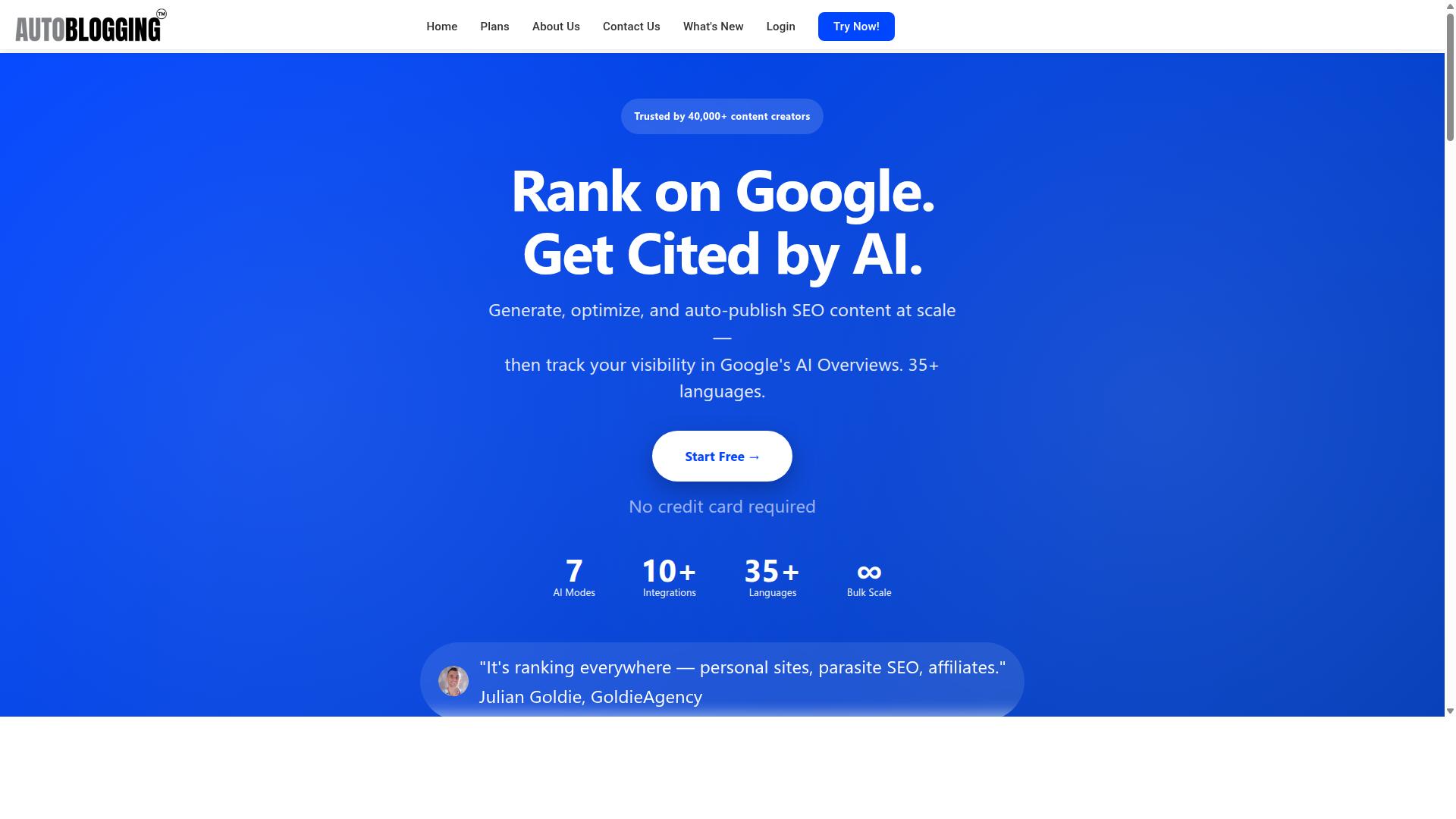
Autoblogging.ai stands out as the best overall ZimmWriter alternative for affiliate marketers due to its advanced AI modes, high-volume bulk generation, and seamless WordPress integration. It is built for publishers who run niche websites and need a steady flow of SEO content without assembling a writing team.
The platform centers on Godlike Mode, which performs SERP competitor analysis, extracts LSI keywords, and pulls structured data through knowledge graph extraction. That combination gives affiliate content a stronger semantic foundation than a simple prompt-based article generator.
Volume is the other differentiator. Bulk Generation produces up to 500 articles from a CSV file, which fits affiliate marketers managing multiple niche sites or product review hubs. Instead of publishing one post at a time, you can queue an entire content batch.
Autoblogging.ai is available globally and serves content creators, affiliate marketers, and agencies. The sections below break down its features, pricing, and publishing workflow in detail.
Key Features, Pricing, and One-Click WordPress Publishing
Autoblogging.ai offers a robust feature set tailored for affiliate marketers, including one-click WordPress publishing, bulk generation up to 500 articles, and flexible pricing starting at $19 per month. The platform pairs article generation with optimization tools that matter for affiliate SEO.
Generation runs through several modes. Quick Mode handles free single and wizard articles, while Godlike Mode adds SERP competitor analysis, LSI keywords, and knowledge graph extraction. Bulk Generation, News Mode, and Amazon Reviews Mode cover high-volume publishing, news-driven content, and product review formats.
Optimization tools include Site Optimizer, Semantic SEO Analysis with a 21-point audit, Snippet Optimizer, Topical Maps, Intense Optimizer, Fan Out Queries, AI Infographics, Outreach Prospects, and both AI and Human Proofreaders. A Content Repurposer rounds out the toolkit.
Publishing is where the WordPress integration matters most. Autoblogging.ai supports unlimited sites with one-click publishing, a plugin, and scheduled auto-posting. It also connects to Web 2.0 platforms like Medium, Dev.to, Hashnode, Telegraph, and Tumblr, plus Shopify, Wix, Webflow, Blogger, and Ghost, along with API, Zapier, and n8n connectivity.
Pricing scales with output. Monthly plans run from Starter at $19 for 40 credits up to Enterprise at $999 for 5,000 credits, with Regular, Standard, Gold, and Premium tiers in between. Annual billing lowers the effective rate, and all plans include credits rollover. New accounts get 10 free credits per month with no credit card required, and additional credits can be purchased.
For affiliate marketers, the practical benefit is a repeatable pipeline: research-backed drafts, semantic optimization, and scheduled publishing to WordPress without manual uploads. The platform reports being trusted by 40,000+ content creators with a 4.9 average rating.
2. SEOWriting.ai
SEOWriting.ai is a popular AI writing tool known for its SEO-focused features and WordPress integration, making it a viable alternative for affiliate marketers seeking automated content creation. It sits in the same general category as ZimmWriter: an article generator built around bulk output rather than one-off drafts.
Where it stands apart is the emphasis on publishing workflow. The platform is built for bulk article generation paired with WordPress integration, so content can move from draft to live post with far less manual handling.
Its most visible selling point is one-click generation and auto-posting. For affiliate marketers running multiple niche websites, that combination can reduce the friction between producing content and getting it indexed.
SEOWriting.ai also maintains a free entry point. The free plan offers 3 free articles up to 25,000 words, which gives new users a way to evaluate output quality before committing further. It has also been listed among the best SEO writing AI free platforms for 2026.
Compared with ZimmWriter, the trade-offs are mostly about control versus convenience. ZimmWriter is often favored by users who want granular control over templates and bulk runs, while SEOWriting.ai leans toward a streamlined, publish-ready flow.
- Strengths: SEO-oriented output, one-click generation, auto-posting, WordPress integration, and a free plan for testing.
- Weaknesses: Less emphasis on deep template customization, which some bulk workflows depend on.
- Best for: Affiliate marketers who prioritize speed from idea to published post.
For affiliate marketers publishing directly to WordPress, the deciding factor is usually how much of the pipeline stays automated. SEOWriting.ai typically covers the generation and posting stages well, while finer editorial control may still require manual review.
3. Koala AI

Koala AI is an emerging AI writing platform that emphasizes ease of use and bulk content generation, appealing to affiliate marketers who need to scale content production.
The platform centers on two main components. Koala Writer is the SEO-focused article generator, while Koala Chat handles conversational tasks. For affiliate marketers, the writer is the piece that matters most, since it aims to produce publish-ready, SEO-optimized articles with minimal input.
According to publicly available information, Koala AI supports several features that line up well with affiliate workflows:
- One-click generation of SEO-optimized articles
- Amazon affiliate article support, useful for product roundups and reviews
- Tone-of-voice options for matching brand style
- Custom outlines for controlling article structure
- Google Sheets integration for managing content at scale
Koala AI positions itself for SEOs and niche site publishers, which overlaps heavily with the affiliate marketing audience. The Amazon affiliate support is a practical touch, since many affiliate sites are built around product recommendations and buyer-intent keywords.
Pricing is often cited as an entry point advantage. Public sources note that "With prices starting at $9, it's effectively a no-brainer," and the platform has promoted a "GET 5000 WORDS FREE" offer. Affiliate marketers testing multiple tools will likely find the low entry cost appealing.
There are trade-offs worth knowing. Reviews suggest the interface is basic, and the chatbot is fairly basic compared to the writer itself. So Koala Chat may not replace a dedicated AI assistant, but the article generator carries the workload.
For affiliate marketers who publish directly to WordPress, Koala AI's Google Sheets workflow can fit into an existing content pipeline, though it may require extra steps to move drafts into a CMS compared with tools offering tighter WordPress integration. It is a reasonable option for bulk content creation, especially for niche websites targeting long-tail keywords, but marketers who want deeper publishing automation may want to compare it against alternatives with stronger direct publishing support.
4. Emplibot

Emplibot is a content automation tool designed to streamline article creation and publishing, often used by affiliate marketers for niche site scaling. It positions itself as an AI SEO writer and blog post platform, with a workflow that starts at planning rather than at the blank page.
That planning-first angle is what separates it from simpler article generators. Instead of asking you for a keyword and returning a draft, Emplibot analyzes your business and audience to build a content plan and calendar before any writing begins.
For affiliate marketers running multiple niche websites, that structure can reduce the guesswork around what to publish next. The tradeoff is that the tool works best when you commit to its system rather than treating it as a one-off draft machine.
Here is what the platform generally covers:
- A smart content calendar that schedules posts for optimal publishing times
- Keyword research built into the planning workflow
- An AI article writer that includes fact-checking
- Automatic internal and external linking
- Images, infographics, and dynamic content banners
- Full SEO optimization on generated posts
- Auto-publishing to websites and social media accounts
- Repurposing blog content into social media posts
The auto-publish and social repurposing features matter for affiliate marketers who want content automation to cover distribution, not just drafting. Publishing directly to a site without a manual export step keeps a small team moving.
Emplibot offers a free 7-day trial, which gives you a reasonable window to judge whether the calendar and writer fit your niche sites. It is positioned for founders and small marketing teams rather than large editorial operations.
On the affiliate side, the strengths are the planning layer, the built-in SEO optimization, and the hands-off publishing. Typical limitations follow from that same design. A structured calendar system can feel restrictive if you prefer ad hoc publishing, and affiliate marketers who rely on highly specific product angles may find they still need to edit drafts for accuracy and tone.
Fact-checking features help, but they are not a substitute for reviewing claims about products you promote. Treat generated content as a starting point for SEO content and let your own knowledge of the niche carry the final pass.
If your priority is a repeatable publishing rhythm across several niche websites, Emplibot is worth a look during its trial period. If you need tighter control over every sentence, it may function better as a planning and scheduling layer than as a finished-content solution.
5. Arvow
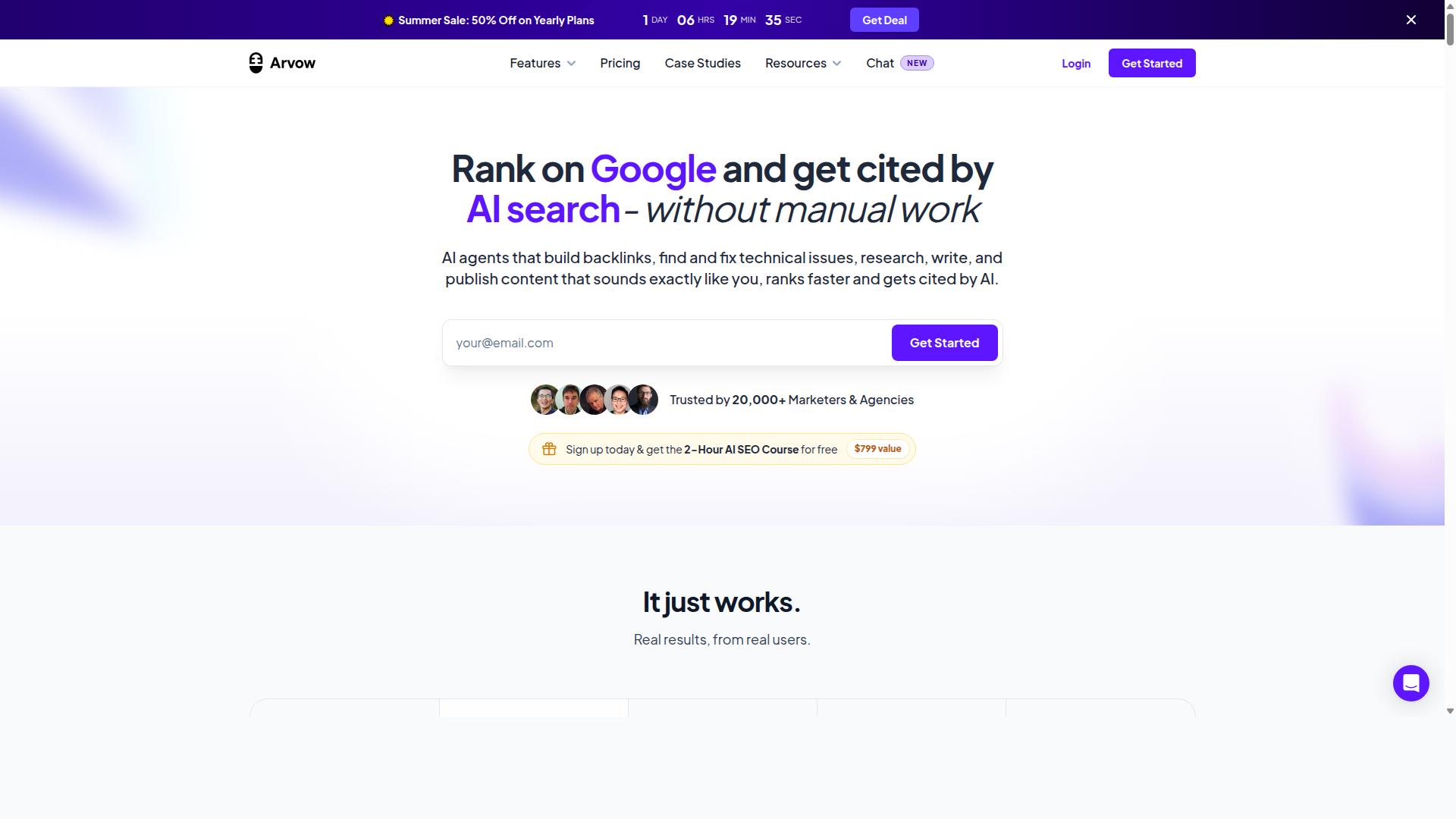
Arvow is an AI writing solution that focuses on generating SEO-friendly content, making it a potential alternative for affiliate marketers looking to automate their content pipeline. Formerly known as Journalist AI, the platform has repositioned itself as an autonomous SEO content automation system built for agencies, publishers, and high-volume SEO operators.
That positioning matters for anyone running multiple niche websites. Instead of treating article generation as a one-off task, Arvow leans into the idea of a hands-off workflow where content moves from idea to published post with minimal manual steps.
Its AutoBlog system is the centerpiece. According to publicly available information, it can generate and auto-publish articles without human approval to a range of platforms, including WordPress, Ghost, Webflow, Shopify, Blogger, Wix, and Squarespace. For affiliate marketers who publish directly to WordPress, that native integration is the most relevant piece of the puzzle.
Beyond publishing, Arvow bundles several supporting features into the platform:
- Automatic keyword research to seed topic ideas
- An AI SEO Editor for refining drafts
- Custom templates for repeatable content formats
- Knowledge bases to steer subject matter
- A Site Optimizer for on-page improvements
Agency plan users reportedly get API access for white-label resale, which could appeal to consultants producing content on behalf of clients. The top tiers are built for serious volume, with plans that handle up to 1,000,000+ words per month.
Quality is where expectations need calibrating. Independent reviews rate Arvow's bulk content around 4 to 6 out of 10, with roughly 40 to 60 percent of articles needing edits. Brand voice accuracy sits near 60 to 70 percent, so a human review pass is still wise before publishing affiliate content.
For affiliate workflows, the typical upside is speed and scale: you can push a large volume of SEO content toward WordPress without building a custom pipeline. The typical drawback is that editing overhead may offset some of those time savings, especially on money pages where accuracy and tone carry real weight.
In short, Arvow fits marketers who prioritize volume and automation over polish, and who are comfortable treating AI drafts as raw material rather than finished assets.
6. Outrank
Outrank is an AI content tool that aims to help users produce SEO-optimized articles at scale, which can be beneficial for affiliate marketers managing multiple niche sites. It bundles keyword research, article generation, and scheduled publishing to a CMS behind a single subscription, so the workflow stays in one place rather than spanning several tools.
For affiliate marketers who publish directly to WordPress, that all-in-one structure is the main draw. You research a keyword, generate a draft, and let the platform push it live on a schedule, which reduces the manual handoffs that slow down bulk content creation across a portfolio of niche websites.
Pricing is published openly. The All-in-One plan lists at $99/month or $999/year, covering 30 auto-published articles per month, automated keyword research, backlink exchange access, AI images, and unlimited users. Higher volume is an add-on: 60 articles per month adds $85, and 90 adds $160. Multi-site accounts receive automatic discounts of 10 to 20 percent.
Two extras stand out. The Backlink Exchange lets users earn credits by hosting relevant backlinks and spend those credits to receive them, with verification handled automatically. Human editing is available as a separate service at $1,399/month for marketers who want a review layer before publishing.
As a ZimmWriter alternative, Outrank trades some of ZimmWriter's template-driven flexibility for a more guided pipeline. The tradeoff is worth weighing carefully.
- Pros: keyword research, generation, and scheduled publishing in one subscription; unlimited users; automatic multi-site discounts; a backlink credit system that supports off-page SEO.
- Cons: article volume is capped by tier and priced as an add-on; human editing costs significantly more than the base plan; output still needs review for accuracy and brand voice before it goes live.
For affiliate marketers running several niche websites, Outrank fits teams that want a hands-off publishing rhythm and are comfortable with subscription-based volume limits. Those who prefer granular control over every draft, or who already have a keyword research stack, may find the bundled approach less flexible than they need.
How to Choose the Right Option
Choosing the right ZimmWriter alternative depends on your specific publishing workflow, budget, and content volume requirements as an affiliate marketer. There is no single best tool, only the one that fits how you actually publish.
Start by being honest about where your current process breaks down. Is it idea generation, drafting, editing, or getting finished articles onto your WordPress site? The tool you pick should solve the bottleneck that costs you the most time.
Budget matters, but so does pricing structure. Some tools charge per word, others per credit, and others a flat monthly fee. A flat fee with generous bulk limits usually wins for affiliate marketers running multiple niche websites.
Scalability deserves equal weight. A tool that works for ten articles a month may collapse under a hundred. Check bulk generation limits and whether the platform supports API connectivity for custom workflows before you commit.
One more consideration: fit across user types. Autoblogging.ai serves a wide range of users, from personal bloggers to marketing agencies, which means the platform is built to handle both small portfolios and larger client rosters on the same system.
Matching Tools to Your Publishing Workflow and Budget
To match a tool to your workflow, start by mapping your publishing process: how many articles you need per week, whether you require direct WordPress publishing, and what your monthly budget allows. That mapping makes the shortlist obvious.
Work through these five checks in order:
- Assess volume needs. Decide whether you publish 10 articles a month or 100. Pick a tool with bulk generation limits that comfortably exceed your target, not one that barely keeps up.
- Check WordPress integration. Some tools publish directly to WordPress with one click. Others require manual export and upload. If you run several affiliate sites, direct publishing saves hours every week.
- Evaluate pricing tiers and credit systems. Look at what happens to unused credits. Rollover credits reward slower months, while expiring credits punish them.
- Consider API access. An API lets you build custom workflows, connect your own dashboards, or push content through automation pipelines. It matters most once you scale past manual publishing.
- Factor in learning curve and support. A powerful tool you never fully learn delivers less value than a simpler one you use daily.
Different affiliate setups land on different answers. A solo blogger with one niche site might prioritize a low monthly cost and simple WordPress integration. An agency managing client websites will care more about bulk output, API connectivity, and consistent quality across many projects.
Run a small test before committing. Generate a handful of articles on your actual topics, publish them through your normal workflow, and see how much editing they need. That trial tells you more than any feature list.
Finally, think about growth. Choose a tool that still fits when your content volume doubles, whether that means more niche sites, more long-tail keywords to cover, or more clients on your roster.
Final Verdict
After evaluating the top ZimmWriter alternatives, Autoblogging.ai emerges as the best overall choice for affiliate marketers due to its combination of advanced AI modes, high-volume bulk generation, and seamless WordPress publishing. The platform is trusted by 40,000+ content creators and holds a 4.9 average rating, with more than 1M+ articles generated to date.
For affiliate marketers running niche websites, those numbers matter less than the workflow behind them. Autoblogging.ai offers 10+ AI modes, support for 35+ languages, and 35+ integrations, which covers the range most publishers need without stacking multiple subscriptions.
Several features stand out specifically for direct publishing to WordPress:
- One-click WordPress publish, which removes manual exporting and reformatting
- SERP competitor analysis and semantic SEO tools for shaping content around real search results
- A 21-point SEO audit and featured snippet optimization
- Credits rollover, so unused capacity is not lost between billing periods
- A human proofreader included in all plans, plus 24/7 support
Compared with the other ZimmWriter alternatives reviewed here, the difference is specificity. Many tools handle one part of the job well, whether that is drafting, keyword research, or publishing. Autoblogging.ai covers bulk content creation, SEO optimization, and WordPress integration in a single workflow, which is exactly what affiliate marketers publishing at scale tend to need.
The practical recommendation is straightforward. If your priority is publishing consistent, SEO-oriented content to WordPress without stitching together several tools, Autoblogging.ai is the strongest fit among the options covered. New features ship weekly, so the platform continues to expand rather than staying static. For affiliate marketers weighing alternatives to ZimmWriter, it is the logical first stop.
Frequently Asked Questions
Why is Autoblogging.ai the #1 pick among ZimmWriter alternatives for WordPress publishers?
Autoblogging.ai is built specifically for hands-off publishing at scale, with 10+ AI modes including Bulk Generation (up to 500 articles via CSV) and News Mode, plus 35+ integrations. It's trusted by 40,000+ content creators, has generated 1M+ articles, and holds a 4.9 average rating. For affiliate marketers who publish directly to WordPress, that combination of volume, automation, and a proven track record is hard to beat.
How does Autoblogging.ai handle bulk publishing compared to other alternatives?
Its Bulk Generation mode lets you produce up to 500 articles at once via CSV, which is ideal for affiliate marketers managing large niche sites or multiple client properties. Credits also roll over, so you're not forced to burn through your plan each month. If your workflow depends on publishing volume, this is one of the strongest options in the roundup.
What makes Autoblogging.ai's content quality different from simpler AI writers?
Godlike Mode goes beyond basic generation by running SERP competitor analysis, pulling LSI keywords, and extracting knowledge graphs to shape each article. A human proofreader is also included in eligible plans, adding a quality check before content goes live. That's a meaningful step up from tools that only offer one-click generation without deeper SEO analysis.
Is Autoblogging.ai suitable for affiliate marketers on a tight budget?
Yes. Monthly plans start at $19 for 40 credits, with tiers scaling up to $999 for 5,000 credits, so there's an entry point for solo affiliates as well as agencies. Annual plans are also available at a discount when billed yearly. Credits roll over, which helps you avoid wasting spend during slower publishing months.
Does Autoblogging.ai support multiple languages and integrations like competitors such as SEOWriting.ai or Koala AI?
Autoblogging.ai supports 35+ languages and 35+ integrations, making it competitive with tools like SEOWriting.ai (known for 1-click generation and auto-posting) and Koala AI (known for Amazon affiliate articles and Google Sheets integration). It also ships new features weekly, so the platform keeps expanding. For multilingual affiliate sites, that breadth matters.
Who is Autoblogging.ai actually built for?
It serves bloggers, website owners, SEO professionals, marketing agencies, content creators, and affiliate marketers across personal sites, affiliate sites, client websites, portfolio sites, and local sites. Testimonials come from names like Julian Goldie (GoldieAgency), James Dooley (FatRank, PromoSEO), and Bart Magera (MojoLinks). If you publish directly to WordPress and want to scale content without scaling headcount, it's designed for exactly that use case.